An illustrated field book • Carey Blackmon
Breeding Rhode Island Reds to Standard
Learn to see the whole bird, make a mating you can explain, and build a family worth passing on.
Rhode Island Reds are my favorite chickens. This book is for the person who wants to understand them well enough to make the next generation better. Read with a current Standard beside you, then take what you learn into the pen. A description becomes useful when you can recognize it in a living bird.
Chapter One
Learning to See a Rhode Island Red
A Mentor, a Bowl of Noodles, and Three Birds That Changed Everything
Before I got the family of Reds I have now, I searched throughout the Southeast for the best birds I could find. I looked, asked questions, and brought home what I thought were some fine Rhode Island Reds. I had done the searching. I had put time into them. Naturally, I wanted to believe I had a good start.
That is an easy place to get comfortable. When you have worked to find something, you begin looking for reasons your choice was right. But the birds do not improve because you worked hard to buy them. They improve when you learn to recognize what is actually there and make better breeding decisions.
As I studied Reds and tried to select for improvement, I found a gentleman named Rip Stalvey. Rip became a mentor to me, and he taught me a ton. He was willing to tell me what he saw. That sounds simple until you are the one asking about birds you already like.
The pictures from my grow-out pen
One day I was sitting in my grow-out pen, looking at what I thought were some fine birds. I took pictures and sent them to Rip for his opinion. I will never forget what he said:
“I wouldn’t put them in a bowl of noodles”
Well, dang.
That was not the assessment I expected. Rip told me that with a lot of hatching and a great amount of culling, I might be able to get close in seven generations. He was talking about the birds in front of me and the work he thought they needed. Seven generations was his estimate, not a formula that guarantees a good flock on a particular date.
I knew then I had a good bit of work ahead of me. I could keep defending the birds I had, or I could learn why a man with far more experience saw them differently. If I wanted better Reds, I needed a better eye.
There is a lesson in that for every breeder. An honest opinion can sting and still be useful. Ask the person to explain it. Which part of the bird is wrong? What should that part look like? Is the problem one bird, the whole family, or the way the picture was taken? A strong judgment becomes a lesson when you can connect it to something you can observe.
I do not want you to read that story and think breeding is a contest to see who can criticize the hardest. It is a responsibility to describe birds honestly. Rip's words stayed with me because he also gave me his time and knowledge. Mentorship is more than a verdict.
The Ohio National, 2023
After a while, I think Rip began to see my dedication. We were going to meet at the Ohio National in 2023, and a few weeks before the show he told me he had a surprise for me. I also knew I would get to meet Sue Dobson.
Sue and I went to look at her birds. The first one she handed me was a beautiful pullet who would later become Susie. Susie won second place at that show. I have not verified the exact class, so I am keeping the account at what I remember rather than turning that placing into a larger award.
Then Sue showed me the best-looking rooster I had ever seen. He was known as Houdini, and that bird could escape. He certainly lived up to the name. There was also another pullet I named Clarabella.
I was standing there looking at those birds like a kid at Toys R' Us with an AMEX Black card. That is about the best way I can describe it. I had spent so much time searching and learning, and here were three Reds that made me stop and look.
Later I found out they were the surprise. Rip and Sue had arranged for those three birds—Susie, Houdini, and Clarabella—to come to me.
Receiving them meant a great deal. So did the help that allowed me to appreciate them. Better foundation birds change your opportunity. Better understanding changes what you do with that opportunity. You need both.
Second place, 2023 Ohio National
Exact class unverified
Known for escaping
Named after coming into the story
What I hope you learn sooner than I did
Do not wait until you have a barn full of birds to find someone who will help you evaluate them. Take a few clear photographs. Write down what you think you see before asking for an opinion. Then compare your notes with the explanation you receive. That is how you discover whether you are noticing the same features.
Learn to separate affection from selection. You can enjoy a chicken, give it a name, and still decide it does not belong in a particular mating. A bird does not have to be worthless to be the wrong breeder for your goal. The question is whether using it moves the family where you want to go.
Also learn to recognize quality without pretending it is perfection. The birds that changed my opportunity still needed a breeder who would observe, keep records, and make choices. A famous name behind a flock does not relieve the next person of that work.
When we discuss width, feather color, mating plans, and records in the chapters ahead, keep that grow-out pen in mind. I was looking at birds I liked. Rip was looking at how far they were from the goal. Learning to close that gap in understanding is where this book begins.
Take this to the pen: Choose one bird you admire. Write three specific reasons. Replace “beautiful” and “good type” with observations another person could check. Then ask a knowledgeable breeder what you missed.
Chapter Two
The Standard Is the Destination
“Bred to Standard” should mean more than dark feathers and a breeder's confidence. It means selection directed toward a defined description of the breed. That description gives people in different places a common destination. Without it, each of us can gradually breed our own preference and keep using the same breed name.
The current American Poultry Association Standard of Perfection is the reference for the APA bird you intend to breed and exhibit. Read the applicable variety and sex, the general requirements, and the faults and disqualifications. Keep the Association's published corrections with your copy. An old quotation can be accurate for its date and still be the wrong instruction today.
The APA recognizes Rhode Island Reds in large fowl and bantams and in single-comb and rose-comb varieties. That does not make every requirement interchangeable. Identify exactly what you are breeding before comparing weights, combs, or proportions. Do not substitute a British or Australian description for an American exhibition requirement merely because the breed name matches. [3]
Read a section, then find it on the bird
Start with one section of the description. If it concerns the back, locate the back on a relaxed standing bird. Notice where the neck feathering ends, how the back carries toward the tail, and what a raised wing or excited posture does to your impression. Look from another angle. Then return to the words.
Next, examine a different bird. It is easy to convince yourself you understand a description when you only apply it to one familiar chicken. Differences make the words useful. Ask a mentor to show you a stronger example, an ordinary example, and a clear fault. Learn the range rather than memorizing one photograph.
Read the whole description again after examining the parts. You can become so occupied with a comb point or an individual feather that you stop seeing the bird. Details matter, but they belong to an animal with a particular shape, balance, and purpose.
Keep three kinds of statements separate
“The bird has a narrow body” is an observation you should be able to demonstrate. “That narrowness will be corrected by this male” is a prediction. The second statement needs a mating and offspring records before it becomes evidence. A breeder who makes that distinction can change a plan without pretending the original observation never happened.
Likewise, a show placing is evidence about an exhibition result, under that judge, against that competition, on that day. It is not a complete breeding test. A winning bird may produce inconsistently; a useful breeder may have a limitation that keeps it out of your show string. Neither statement excuses disregarding the Standard. It asks you to judge breeding usefulness with more information.
Make your reference sheet without inventing a new standard
Create a working sheet with the anatomical sections you need to inspect. In a reference column, record the page and edition of your Standard. In a second column, write observations. Leave a third column for questions. You do not need to reproduce the entire copyrighted description to make a useful field sheet.
Use the published weights and requirements directly from that current reference. This book deliberately does not supply an unverified table of official measurements, point deductions, or disqualifications. Getting one of those numbers wrong would be worse than asking you to open the book that governs the decision.
The APA's 45th-edition correction sheet illustrates why this habit matters: it includes corrections to the Rhode Island Red description, including the female wing carriage and details of the male. Check the correction applicable to your edition rather than assuming a copied passage is final. [4]
Do not confuse a helpful shorthand with the whole bird
Breeders often describe Reds with words such as long, deep, broad, or rectangular. Those words help direct your eye. They do not mean the bird is a literal box, that every line should be forced straight in a photograph, or that adding more length always makes a better Red.
A shorthand becomes harmful when it encourages an extreme. Length without width can produce a narrow bird. Depth supplied by loose feathering can fool you about the body underneath. Size can be mostly excess condition. A very dark surface can distract you from uneven color and poor structure.
Make yourself answer a complete question: does this bird approach the required breed character as a whole, with the appropriate details for its sex, age class, and variety? That takes longer than saying “nice color.” It also gives you something useful to breed toward.
Take this to the pen: Read one Standard section aloud, examine two birds, and write what you can observe. Mark every prediction with “I expect” until offspring give you evidence.
Chapter Three
Read the Old Breeders Carefully
Old poultry literature is valuable because it lets us hear what breeders were trying to solve. It also tempts us to treat age as proof. A claim printed a century ago may preserve an excellent observation, a limited experiment, a fashionable explanation, or a mistake. We owe the author an honest reading and the birds an honest test.
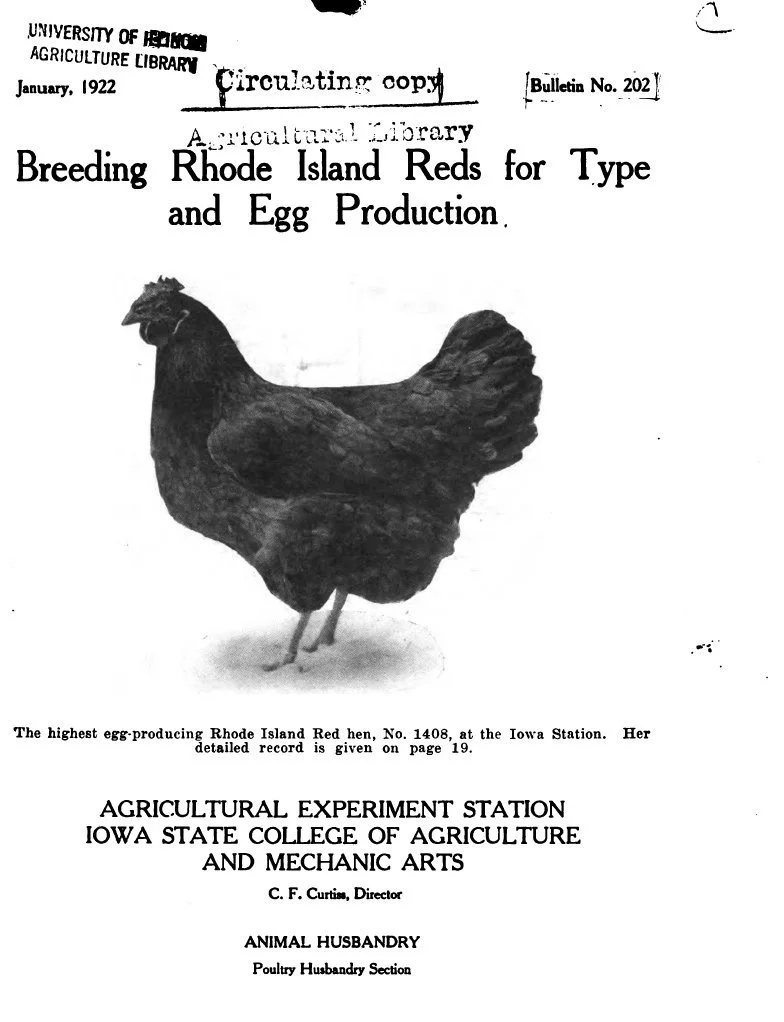
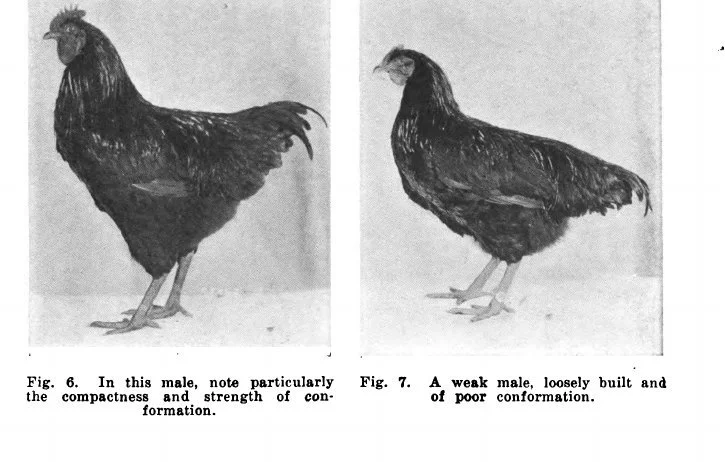
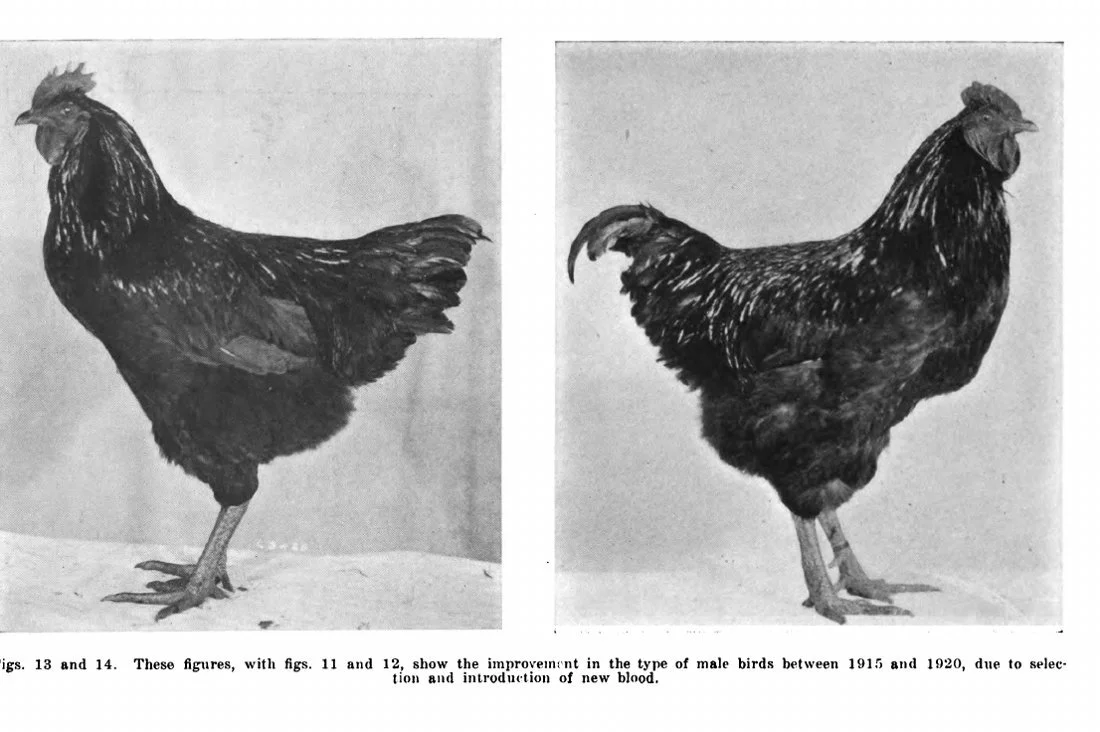
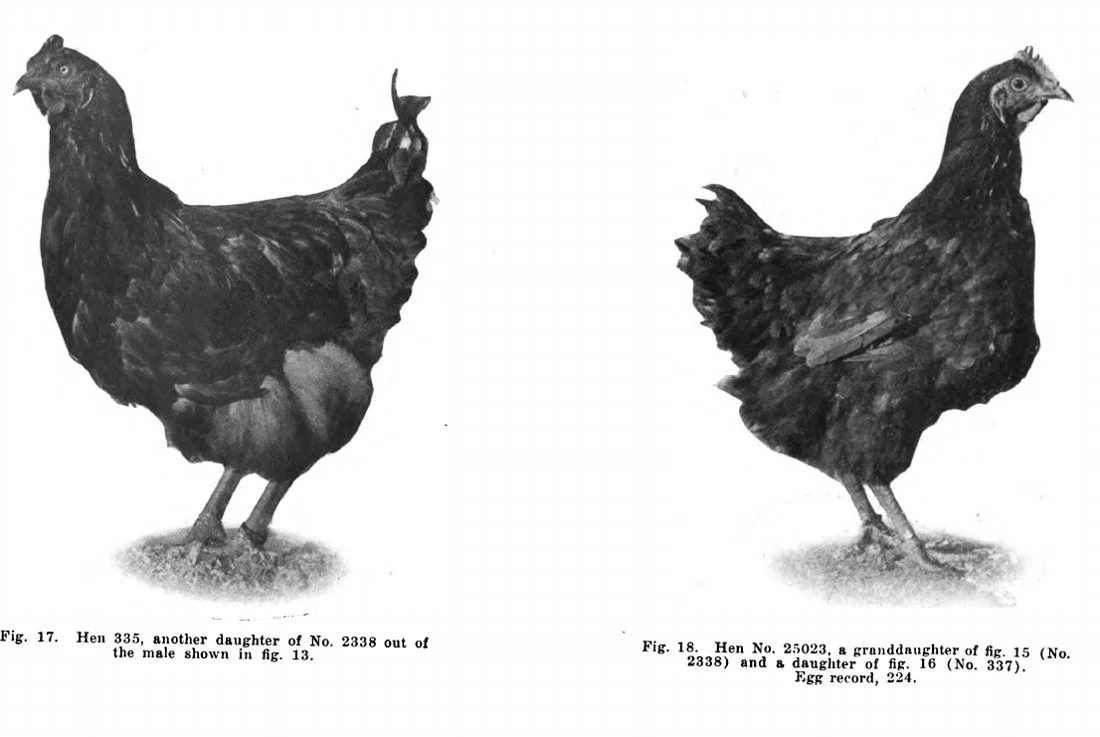
The supplied PDF named Breeding Rhode Island Reds for Standard contains H. A. Bittenbender's January 1922 Iowa Agricultural Experiment Station Bulletin No. 202. Its cover title is Breeding Rhode Island Reds for Type and Egg Production; the interior title includes “Standard Type.” The actual subject joins breed character and production. It is not a modern APA standard. [1]
What the Iowa work actually contributes
The bulletin describes a flock whose trap-nest records began in 1908 and whose selection placed particular attention on breed type and color from 1917. The researchers compared birds, recorded laying, made matings, and followed offspring. That gives us something more useful than a collection of opinions: an account of decisions attached to identifiable birds.
One particularly useful observation is that a rectangular side view can conceal insufficient width. Another is that breeders were already trying to preserve production while improving color. Those are still worthwhile questions. They do not require us to accept every explanation the author offered for vigor or inheritance.
When the bulletin links the shape of a head, a bird's apparent timidity, or a finger-width measurement to production, read it as the author's historical interpretation. A photograph cannot establish disease resistance. A handling impression cannot replace an egg record. Modern use of that material should improve the questions we ask, not give us a shortcut to declaring a bird healthy or productive.
Card's 1920 argument
The other historical source is W. H. Card's “The Modern Rhode Island Red Fowl,” published in the January 1920 issue of Everybody's Poultry Magazine, pages 13, 32, and 33. Card addressed Rhode Island Red fanciers in Denmark and argued for a bird that combined exhibition character with practical usefulness. He discussed color, related breeding, and the disagreements between utility and exhibition interests. [2]
Card's enthusiasm is part of the evidence. It tells us how an advocate spoke about his breed. It does not turn promotional language into a controlled comparison. Nor should his assurance that an established line can continue indefinitely without deterioration become a promise we make to today's breeder. Related matings still require attention to genetic diversity and reproductive performance.
His comparisons between breeding colors and mixing pigments also need care. A mating is not a paint bucket. Two parents pass combinations of genes, and different offspring can express different combinations. A dark bird and a light bird do not obligingly produce a pen of uniform medium birds.
A four-question method for historical reading
First ask what the author observed. Did the author count eggs, record chicks, compare photographs, or repeat something another breeder said? Then ask what conditions are described. Birds raised together offer a more useful comparison than birds from unknown places, although shared management alone does not settle every cause.
Third, identify the explanation. Does the evidence demonstrate it, or did the author infer it? Finally, ask what would make the claim useful now. Sometimes the answer is a repeated mating. Sometimes it is an individual production record. Sometimes the claim should stay in the historical chapter.
For example, Bittenbender reported 238 eggs in the first recorded year for hen 1408. That is a record for a particular historical bird, not an annual promise for all Reds. His categories for high, medium, and low production belonged to that study. Copying those categories into a modern sales description without their setting would mislead the reader.
Preserve the credit and the limits together
The historic illustrations in this book are reproduced from the supplied 1922 U.S. publication, now in the U.S. public domain. Captions identify the publication and figure numbers when available. Cropping and rotation improve readability; no modern bird is substituted into a historic figure.
The supplied coloring page is different. It bears a club crest but does not establish the artist, publication date, or a reuse license for the hen illustration. It is therefore not reproduced here. A club logo on a page does not, by itself, document rights to every image on that page.
Take this to the pen: Choose one historical recommendation. Write “observation,” “explanation,” and “test” on three lines. If you cannot separate them, you are not ready to use that recommendation as a breeding rule.
Chapter Four
See the Body Before the Color
A rich red coat can make you generous about everything underneath it. Resist that. Begin your first look with the shape and balance of the bird. If the body is wrong for your purpose, attractive plumage does not put the missing structure back.
Give the bird room to stand naturally on secure footing. An anxious chicken stretching its neck against wire is not showing its ordinary outline. Neither is a bird crouched because it is being crowded. Watch before handling. Let it walk, turn, and settle. Your first responsibility is to distinguish the bird from the pose.
The side view is only the beginning
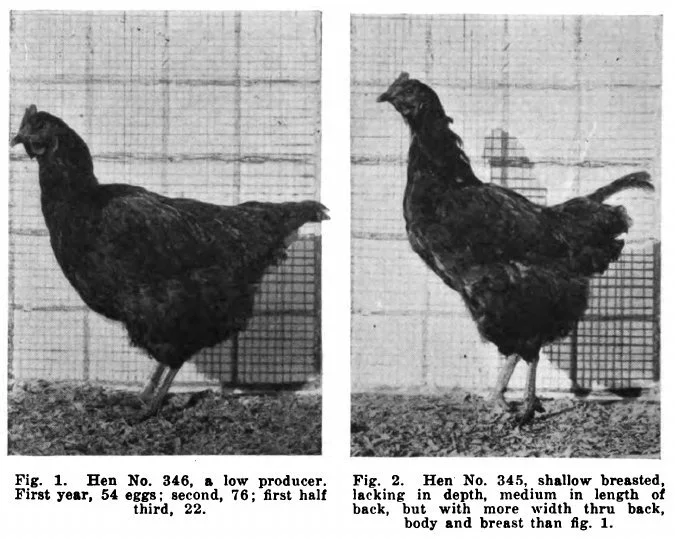
From the side, consider the relationship of back, breast, body, and tail. Look for the length and depth that give the Red its characteristic impression. Then move around the bird. A long silhouette is not proof of adequate width. The Iowa bulletin made that point in 1922, and its photographs remain useful for learning to ask the question. [1]
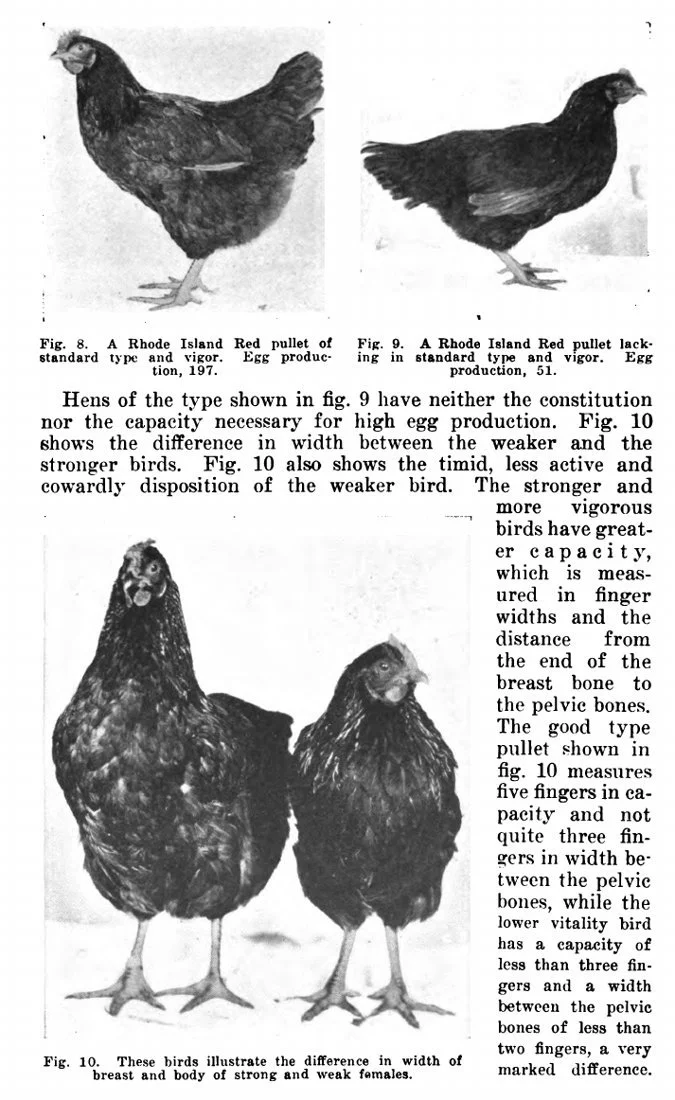
Look from the front for the impression of breadth through the breast and how the legs support the body. From behind, consider whether the body appears to retain useful width toward the rear. From above, where a calm bird can be observed safely, look for narrowing that was hidden in the side view. Do not use one angle to answer every question.
When you handle a bird, support it securely and calmly. Feathering can hide the difference between body and outline. Your hands should help you understand structure and condition, not force a chicken into the shape you want to see. If you are unsure how to handle it safely, have an experienced person demonstrate.
Length, depth, balance, carriage
Breadth, support, symmetry
Width carried through the body
Balance is a relationship
Suppose one bird has a longer back than another. That fact does not settle which is better. Consider whether the breast, body depth, width, neck, and tail belong together. You are breeding a complete bird, not winning a competition for the longest isolated measurement.
A useful exercise is to describe the bird without praising or condemning it. “The body narrows visibly behind the wings” is more informative than “poor type.” “The tail carriage changes when the bird relaxes” tells you to watch longer. Specific language prevents your initial impression from becoming the only evidence.
Separate three concerns: structural form, temporary posture, and body condition. A frightened pose may disappear when the bird settles. Excess condition can change the feel of the body. A persistent structural limitation remains when the bird is compared fairly. You may need repeat observations before deciding which concern you are seeing.
Compare birds at a fair stage
A younger bird may look less finished than an older one because it is less finished. Record hatch dates. Compare like age groups where possible, and note differences in maturity rather than quietly treating them as permanent faults. The fastest-looking youngster is not automatically the best mature breeder.
At the same time, “it will grow out of it” can become an excuse that keeps every bird. Set another review date. Specify the feature you expect to change. When that date comes, look at the same feature and record the result. Patience is useful when it has an observation plan.
Photographs help if you make them comparable. Work near bird height. Use a reasonable distance and avoid an extreme wide-angle view. Photograph the same side and include front and rear views when possible. Keep the band number and date with every set. A dramatic picture is less useful than a repeatable one.
A worked evaluation
Imagine two same-age pullets. Pullet A has a pleasing long side profile but narrows markedly behind the wings. Pullet B appears slightly less striking at first, yet carries more consistent width and has a fuller body. This is a teaching example, not a claim about a particular pair in my flock.
Do not decide solely from the first glance. Compare each with the current description, examine condition, and ask whether the difference persists as they move. If B is closer overall, record why. If A carries some important strength you want to preserve, that belongs in a separate mating discussion. It should not erase the narrowness from the evaluation sheet.
Now imagine both have excellent color. Nothing about that color resolves the width question. This is where disciplined selection begins: refusing to let one quality answer an unrelated question.
Take this to the pen: Evaluate three birds before discussing color. Use side, front, and rear observations, then explain your order of preference in complete sentences.
Chapter Five
Details That Must Belong to the Whole Bird
Once you understand the overall body, work through the details in the same order every time. A consistent routine helps you notice what familiarity makes easy to overlook. Head, comb, eyes, beak, wings, tail, legs, feet, feather condition, and movement all deserve attention.
This chapter teaches an examination method. For exact shape, color, size, permitted markings, faults, and disqualifications in each section, use the current Standard and its corrections. Do not let an attractive illustration in this book replace that reference.
Head and expression
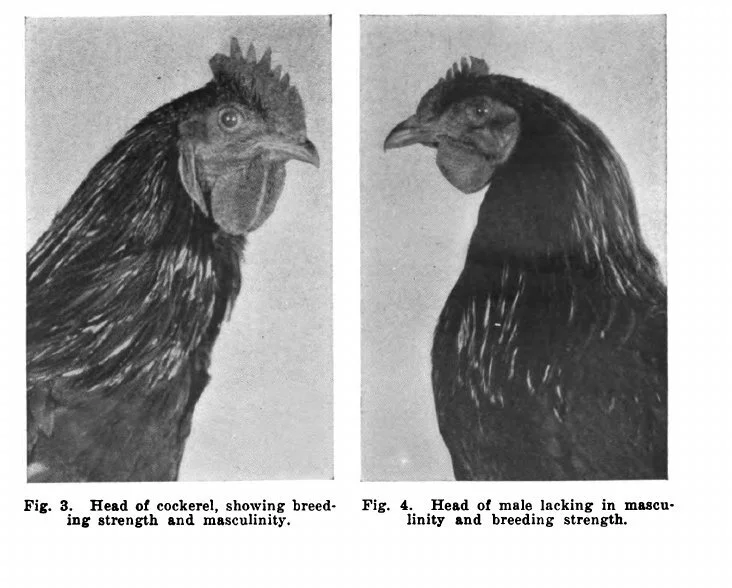
Look at the head in relation to the bird. Inspect symmetry and the features relevant to its variety and sex. A bold-looking head may catch your attention, but an impression of masculinity is not a fertility test. An alert-looking eye is not a laboratory result. Appearance tells you what deserves closer investigation; it does not answer every biological question.
The Iowa bulletin illustrates contrasting cockerel heads and interprets them in terms of breeding strength. Use those photographs to practice observing differences in outline and expression. Do not turn them into a rule that lets you diagnose vigor from a headshot.
Comb and variety
Identify whether you are examining a single-comb or rose-comb Red. Read the appropriate description before deciding a feature is desirable. Do not rank a bird against the wrong variety simply because the rest of the flock looks different.
Distinguish a developmental or inherited concern from an injury when evidence allows. Record damage and its history rather than silently removing it from your notes. A bird's show eligibility and its potential breeding usefulness are related decisions, but they are not identical decisions. The current rules govern the show; records and informed judgment govern the mating.
Wings and tail
Observe how the wings are carried when the bird is relaxed and moving normally. Compare both sides. A problem seen once while the bird turns may be posture; a repeated one deserves closer attention. Inspect the feather sections relevant to the Standard without pulling or damaging them.
The tail contributes to the entire outline. Consider its relationship to the back and the rest of the bird rather than admiring it in isolation. Check that the apparent carriage is repeatable. A picture taken at an excited moment can exaggerate a feature you would judge differently after watching the bird settle.
Broken, missing, or growing feathers complicate the picture. Write “not assessable in current feather” when that is the truth. Guessing produces a tidy record and a poor decision. Schedule a later examination when the feature can actually be evaluated.
Legs, feet, and movement
Watch the bird walk on suitable footing. Does it move comfortably and support itself normally? Inspect both legs and feet, and distinguish the visible condition from an assumed cause. A limp should not become a genetic diagnosis merely because the bird is in a breeding pen.
Soundness matters before fine points. A chicken unable to move or mate comfortably needs care and investigation. Avoid selecting only from still pictures. A still picture may make a functional problem easy to miss.
Record shank color separately from soundness. Yellow intensity, dark pigment, staining, and surface condition are different observations. We will examine the genetic and management questions behind visible shank color in Chapter Seven.
Make uncertainty visible
Use clear entries: observed, not observed, uncertain, and recheck. They are more useful than forcing every line into good or bad. An uncertain observation can be resolved later. A confident but mistaken label may steer several generations.
Keep your descriptions respectful when discussing another breeder's birds. Explain the feature, the reference you are using, and the limits of your view. “I cannot evaluate the tail from this photograph” is a better answer than inventing certainty. An honest limit strengthens your advice.
Take this to the pen: Write an examination order on a card. Follow it with five birds. Every time a section cannot be assessed fairly, record the reason and a recheck date.
Chapter Six
Red Color Is More Than Darkness
When people first become interested in exhibition Reds, darkness often becomes the whole conversation. They want the darkest bird they can find. But color quality involves distribution, evenness, the correct sections, feather condition, and how the surface relates to what lies beneath it. “Darker” is not a complete mating plan.
Use the current Standard for the required color of each section and sex. Do not convert a historical author's preferred shade into a new official requirement. The illustrations reproduced here are monochrome, so they cannot establish the actual red hue of the photographed birds.
Compare under consistent conditions
Look at birds in comparable, neutral light. Deep shade, warm artificial lighting, direct glare, and phone processing can change your impression. If you compare photographs, check whether the exposure and white balance differ before blaming the birds.
Feather age matters too. A recently renewed feather and a worn feather have not had the same history. Note molt and feather condition on the record. Do not call every change in surface appearance a change in genotype.
Examine corresponding sections. A quick glance at the whole bird can conceal unevenness between neck, back, breast, and body. Open and inspect the relevant feather areas gently, then return the bird to its normal position. Record the exact location of the feature instead of writing only “too light” or “too dark.”
Surface and undercolor
Surface color is what you see first. Undercolor is hidden until you examine the feather more closely. They are related parts of the plumage, but they are not interchangeable observations. A bird that looks even at a distance may reveal features that matter to your breeding decision when handled.
In the Iowa study, Bittenbender discussed slate, smoky undercolor, excess black, white, shafting, and mealiness. He made mating suggestions based on what he observed in that flock. These are valuable historical records of a breeding problem, not universal genetic equations or permission to ignore today's Standard. [1]
Do not breed by a paint-mixing story
Card used pigment comparisons to discuss Red color in 1920. Bittenbender also warned against assuming a dark male and light females would produce the desired even shade. Their practical concern is understandable. The modern lesson is to avoid expecting an average color simply because the parents sit at opposite extremes.
Offspring inherit combinations, not a blended sample of the parents' feathers. Even when two parents look similar, they may differ in genetic factors they carry. The appearance of their young, especially across more than one hatch, provides information you cannot get from the parents alone.
This does not mean matching appearance has no value. It means appearance is a starting observation. Mate with a reason, identify the chicks, and check the results. If the offspring show an unwelcome pattern, keep the record. Do not rewrite the mating explanation after the fact to make every outcome look intentional.
Name the feature precisely
Breeders use terms such as shafting and mealiness to discuss uneven feather appearance. Have an experienced breeder show you actual examples and compare them with the applicable wording. A photograph can help, but lighting and resolution may hide the feature.
Be equally precise about black. Black belongs in specified parts of a Red's plumage. “Black is bad” is as careless as “more black makes better red.” The location, extent, and applicable requirement matter. An observation needs an anatomical address.
Likewise, avoid excusing every white feather as age or blaming every white feather on a single inherited cause. Record when and where it appeared, the bird's age and feather condition, whether the observation repeats, and what appears among relatives. Seek an experienced opinion when the breeding consequence is substantial.
A workable color notebook
Make one row for each bird and separate columns for the sections you examine. Use the same light where practical. Include the date, molt status, and photograph references. If a bird cannot be compared fairly, say why. This creates a much better record than a folder of unlabeled “nice Red” photographs.
When evaluating the next generation, ask whether the proportion of suitable birds improved. One outstanding youngster can conceal an inconsistent family. A mating that produces a useful, repeatable group may be more valuable than one that gives you a single dramatic bird and many problems.
Take this to the pen: Compare three birds in the same light. Describe each color concern by location and appearance. Make no prediction about inheritance until you have labeled it as a prediction.
Chapter Seven
Understand Shank Color Without Oversimplifying It
The shanks give you another opportunity to confuse what you see with why you see it. A pale-looking leg, a dark wash, and a yellow leg with surface staining are not the same problem. Begin by describing the appearance accurately, then investigate its explanation.
The supplied shank-color document is useful as a list of questions, but its dominant-versus-recessive color categories are too simple. There is no single dominance ladder in which white, black, yellow, and willow all compete as alternative versions of one gene. Visible color reflects interacting pigment systems and genetic factors.
Yellow pigment and dark pigment are different questions
Yellow skin involves the handling of carotenoid pigments obtained from the diet. Eriksson and colleagues identified the yellow-skin association with regulatory variation affecting BCDO2, now commonly called BCO2. Reduced expression in skin permits yellow carotenoids to accumulate. This supports a genetic explanation for yellow skin; it does not say feeding more pigment will correct every undesirable shank appearance. [5]
Dark pigmentation involves melanin and its location in the skin. The inhibitor of dermal melanin, traditionally written Id, is sex linked. Li and colleagues' 2026 paper reports a structural variant regulating CDKN2A associated with this trait. The uploaded article cited the 2024 preprint; the published paper is the more current reference used here. Neither source establishes a universal shank-color recipe for every flock. [6]
Why the sex of the bird can matter
Male chickens have two Z chromosomes; females have one Z and one W. A factor on the Z chromosome can therefore produce different inheritance expectations depending on which parent carries it and the sex of the offspring. A pen of sons and daughters should not be treated as interchangeable evidence when investigating a sex-linked trait. Other genes can modify shank appearance, so a simple illustrative cross is not a complete flock prediction. [7]
You do not need to guess genotypes to keep better records. Identify the sire and dam or dam group, record each chick's sex when established, and describe the color at comparable ages. If the same pattern repeats across identified families, you have a useful question to take to someone with genetics expertise. If parentage is mixed, say so.
Laying changes what you are looking at
In yellow-skinned laying hens, yellow pigmentation can diminish during production. Extension guidance describes a sequence of pigment loss through different body regions, with the shanks changing later than some other areas. That makes reproductive stage relevant when comparing hens. Pale shanks alone do not prove an inherited lack of yellow skin, and bright yellow shanks alone do not prove superior production. [8]
Compare birds of similar sex, age, and production stage where possible. Note whether a hen is laying, resting, or molting when known. If you do not know, record “unknown.” You will learn more from that honest entry than from a confident explanation built on an assumption.
Do not reach for an additive before a diagnosis
Keep a suitable complete ration and record meaningful feed changes. A pigment-focused feed experiment can make your observations harder to interpret if you change several things at once. Do not assume a mineral supplement is required because a leg looks pale, and do not use this chapter as a dosing guide.
For a breeding decision, the most useful first action is often another observation under comparable conditions. For a bird with signs of illness or impaired movement, get an appropriate health assessment rather than trying to solve everything as a color problem. Appearance is the beginning of the investigation.
Take this to the pen: Photograph the same hen's shanks at several known stages, keeping light and camera position comparable. Put laying status and feed history beside the photographs before interpreting the change.
Chapter Eight
Select Through the Whole Growing Season
You do not need to make every decision at the first inspection. You do need to know which decisions are appropriate now and which require more development. A selection program is a sequence of observations, not one afternoon when every young bird is declared a keeper or a failure.
Plan capacity before hatching. How many birds can you raise with adequate space, feed, water, shelter, and attention? How many can you keep long enough for a fair evaluation? A large hatch that overwhelms your facilities can leave you with poorer evidence and poorer welfare than a smaller, well-managed group.
Give each group an identity
Attach a hatch date and family identity to the group from the start. Maintain individual identification when the system and age permit, checking regularly that bands or other devices remain safe and appropriate as birds grow. A number only helps if it stays attached to the right record.
Record uncertainties immediately. If chicks mix and individual parentage is lost, retain the information you still know, such as hatch group or sire group. Do not reconstruct a precise pedigree from appearance. “Unknown dam within pen B” is usable information. An invented dam is a future mistake.
Early reviews answer early questions
Early observations can flag welfare needs, identification problems, and features that need follow-up. They should not pretend to settle every mature breed characteristic. A chick's juvenile appearance is not a complete picture of its adult plumage, outline, or reproductive value.
Write down why you retain a bird for later review. Perhaps you need to see how its body develops, how its feathering finishes, or whether a temporary concern persists. Set a next assessment date appropriate to the family and your observations. Avoid turning an example age into a universal rule for all Reds.
When a bird is removed from the breeding pool, record the reason. In this book, “culling” means selection out of that pool. It does not mean neglect, and it does not automatically prescribe killing. Responsible disposition depends on the bird, its welfare, health status, and an honest description of its limitations.
Compare within groups, then across the flock
Within a same-age group, you can begin to see the range of outcomes from a mating. Across groups, you can ask whether one family is consistently stronger in the feature you are trying to improve. Keep management differences visible. A group raised under a different condition is not a clean genetic comparison.
Do not select only the single most impressive bird from every hatch and ignore the rest. The distribution matters. If a mating repeatedly produces a narrow body, one broad youngster does not make the issue disappear. Conversely, a family with many suitable birds may deserve more attention than its most spectacular rival.
Use a short list of priorities
You can inspect many traits while concentrating improvement on a few. List the most important limitations in your family and put them in order. Keep soundness and essential breed requirements in view, then define the specific improvement you hope to measure.
A vague goal such as “better birds” gives you no way to judge a season. “Retain more width through the rear body while preserving the strengths already present” is a goal you can discuss and compare. It still requires a definition of what you are observing and a fair reference group.
Photograph the middle of the group as well as the best. The ordinary birds tell you what the mating commonly produces. If your album contains only winners, your memory will gradually turn every breeding season into a success.
The final review is a fresh evaluation
A bird selected provisionally deserves another full examination before entering a breeding pen. Confirm its identification, current condition, and the traits that justified keeping it. A decision made months earlier is not a permanent exemption from scrutiny.
Review the backup birds too. A backup should be a considered option with known strengths and limitations, not simply the last male you failed to sell. Record what would change in the mating plan if you had to use him.
Take this to the pen: For each retained youngster, write “kept because,” “still uncertain,” and “review again.” If every bird has the same answer, make your observations more specific.
Chapter Nine
Make a Mating You Can Explain
A mating plan should fit on paper before it occupies a pen. Name the birds. State the goal. Identify the strengths you intend to preserve and the weaknesses you are trying to reduce. Say what offspring result would persuade you to repeat the mating.
This discipline does not remove uncertainty. It makes uncertainty useful. If the outcome differs from your expectation, you can learn which assumption failed. Without a written expectation, it is easy to discover afterward that you supposedly planned whatever happened.
Start with the family you have
Inventory your available breeders honestly. Include age, identification, relevant relatives, previous matings, and offspring observations. A bird with a known production history offers different information from a promising youngster. Do not give them the same certainty simply because you like both.
Ask whether the proposed pair shares the same important limitation. Two birds with the same weakness may reinforce a concern rather than correct it. Pairing opposite extremes is not automatically a solution either. “One is too much and the other too little” is a description, not evidence that the offspring will fall in the right place.
A worked mating decision
Consider a teaching scenario with two males. Male A has strong width and acceptable overall balance but a color concern that needs careful evaluation. Male B has more appealing surface color but shares the hens' tendency to narrow behind the wings. The season's priority is body width.
You cannot choose intelligently from those two sentences alone. Check the current requirements, the seriousness of each concern, the birds' family records, and their reproductive suitability. If a defect makes a bird inappropriate to use, a useful feature elsewhere does not cancel it.
If A remains a reasonable candidate after that review, a limited, clearly identified test mating may answer a focused question. Keep a separate comparison where capacity permits. Evaluate the resulting group for both width and the color concern. Do not call the mating successful because it improved one trait while creating a larger problem elsewhere.
If neither male is suitable, the correct plan may be to obtain better foundation stock or delay the mating. Available does not mean appropriate. There is no prize for hatching a problem you already understand.
| Question | Entry to make before hatching |
|---|---|
| What will improve? | A clearly described feature, not “quality” in general |
| What must be preserved? | Existing strengths and essential requirements |
| What could go wrong? | Shared faults, uncertain inheritance, limited parentage records |
| How will I know? | Comparable offspring observations, counts, photographs, and a review date |
| What is my next decision? | Repeat, revise, stop, or gather more evidence |
Know what your pen records actually prove
A single-sire pen with several hens can identify the sire group without identifying each dam. Individual dam records require an appropriate system that maintains that link. Do not label a pen mating an individual pedigree merely because all parents have names.
Changes of males also require care about parentage. Do not assume eggs laid immediately after a change belong to the new male. Establish a defensible identification protocol with experienced guidance and record transition eggs separately when parentage is uncertain. Better to exclude doubtful pedigree data than build certainty on a calendar guess.
Count all the relevant offspring
Before selecting your favorite, record the number hatched and the number available for each review. Note deaths, missing records, and birds removed for known reasons. Otherwise the surviving group can appear better than the mating's full outcome.
If ten youngsters reach evaluation and seven are useful candidates, that is a different result from one useful candidate among ten, even if the best bird in the second group is more striking. These are illustrative numbers. They show why a count adds information that a champion photograph cannot.
Small groups deserve modest conclusions. A few chicks may reveal a concern worth investigating, but absence of a fault in a tiny hatch is weak evidence that the parents cannot transmit it. Repeat when justified and feasible, without hatching more birds than you can responsibly raise.
Decide at the end of the season
Compare the results with the written objective. Did the intended feature improve? What happened to the traits you meant to preserve? Did reproductive performance and general soundness remain acceptable? Which observations are strong enough to guide the next mating, and which remain uncertain?
Write a short conclusion while the birds and records are in front of you. A useful conclusion can be disappointing: “Do not repeat this combination; the shared body concern persisted.” That sentence may save a season.
Take this to the pen: Before setting eggs, write one paragraph explaining each mating and the result that would make you change your mind.
Chapter Ten
Related Breeding, Outcrossing, and Keeping Options
A family of Reds becomes recognizable because breeders make choices over time. The name attached to that family can help tell its story, but the living birds and their records tell you what you actually have. Preserve the strengths, study the weaknesses, and avoid letting loyalty to a name prevent an honest decision.
Related breeding increases the chance that offspring receive matching inherited material from shared ancestors. Breeders may use it to concentrate characteristics, but it can also expose harmful recessive effects and contribute to loss of performance. “Linebreeding” does not make those biological concerns disappear. It is a breeding approach within related animals, not protection from the consequences of relatedness.
Read Card with this distinction in mind
In 1920, W. H. Card strongly favored establishing and maintaining related lines. He described parent-offspring matings and expressed confidence in the long-term vigor of established families. That is an important historical position. It is not a guarantee that a small present-day flock can be bred closely indefinitely without monitoring its results.
The lesson to retain is deliberate selection within a known family. The lesson to reject is that a famous breeding method excuses missing records. If fertility, hatchability, survival, or soundness changes, investigate. Do not explain every decline away because the mating follows a diagram you admire.
Know the relationships you can document
Draw the parents and grandparents you actually know. Mark unknowns. Two birds from different sellers may still be closely related, while two birds carrying the same line name may have more complicated histories than the label suggests. Ask for records and keep the answer with the birds.
Do not assign exact inbreeding values from an incomplete pedigree. A calculation is only as sound as its inputs and assumptions. If a detailed relationship analysis becomes important, use appropriate expertise and a documented pedigree. A neat percentage can hide an enormous amount of missing history.
Recorded strengths and concerns
Recorded strengths and concerns
Keep more than one route forward when feasible
A program that depends entirely on one male and one mating is vulnerable to loss, infertility, and a mistaken selection decision. Within your capacity, preserve suitable alternatives and their records. That does not mean keeping every bird. It means choosing backups for a reason.
If you work with another breeder, agree on identification and record sharing before exchanging stock. “We both have Reds” is not enough information to coordinate preservation. Record where birds came from, what matings produced them, and any known uncertainty about parentage.
Keep the exchange practical. A simple shared record with accurate bird IDs is more useful than an elaborate pedigree graphic nobody updates. Decide who records hatch results, who retains which family, and how corrections are communicated.
An outcross is a change to test
Bringing in another bird may supply something your flock lacks. It also brings a genetic combination whose effects may become clearer in later generations. Do not assume an attractive first cross settles the long-term outcome.
Write the reason for the introduction. Is it a specific structural strength, a need for a broader breeding base, or replacement after a loss? Keep the introduced family and its descendants identifiable. If space permits, preserve an appropriate portion of the existing family while you evaluate the change.
Ask what evidence the source breeder can provide. Look at relatives, not only the bird offered for sale. Ask about recurring concerns and the conditions under which the birds were raised. A breeder willing to discuss limitations may give you more useful information than one offering perfection.
Protect health as well as identity
New stock should enter through a biosecurity plan appropriate to your flock and current conditions. Consult current poultry-health guidance and your veterinarian about separation, testing, and other precautions. A bird's pedigree does not establish its health status, and an apparently healthy arrival should not be treated as proof that it cannot introduce disease.
Keep health events separate from genetic conclusions until you have evidence. A fertility decline can involve management, health, age, environment, or breeding relationships. Record the problem and investigate the alternatives rather than choosing the explanation that is most convenient.
Take this to the pen: Draw the relationships of your planned breeders. Circle every unknown. Then write the backup plan if your first-choice male cannot be used.
Chapter Eleven
Keep Production in the Picture
A Rhode Island Red is a living breeding animal, not a painted outline. If a family becomes harder to reproduce or maintain while its show photographs improve, you need to understand that tradeoff. Type, color, soundness, and useful performance deserve records of their own.
The Iowa bulletin is especially valuable here because it followed identified hens over time. Its authors tried to improve breed character without abandoning egg production. We can appreciate that objective while recognizing that their flock, management, and production categories belonged to their period.
A historical hen with an actual record
Hen 1408's annual totals in the 1922 bulletin are 238, 207, 198, 183, and 122 eggs across five recorded years. Those numbers describe that hen in that study. They are not a breed guarantee, a modern selection threshold, or proof that the cover photograph predicts production. [1]
The value of the table is not simply that the first number is large. It shows a sequence. One impressive season and several disappointing seasons tell a different story from sustained usefulness. Age and conditions matter, so the comparison should remain attached to the history.
Define the count before comparing it
If you report eggs per hen, define the period and how the count was obtained. Is it an individual record or a pen total divided by the number of hens? Were all hens present for the same period? Were eggs missed? Did a hen leave the group? Those details determine what the number means.
A pen average can describe the pen. It cannot tell you which hen laid which egg. If individual selection depends on that distinction, use a recording method that can establish it without compromising welfare. Do not turn a group average into an individual achievement.
Record laying interruptions and known causes when available. Molt, broodiness, management changes, and health events can alter the interpretation. “No eggs recorded” is an observation. “Genetically poor layer” is a much stronger conclusion.
Separate fertility from hatchability
When you assess reproduction, keep the denominator visible. Eggs set, eggs determined fertile by an appropriate assessment, chicks hatched, and chicks surviving to a defined review are different counts. If fertility was not assessed reliably, mark it unknown.
A worked example makes the difference clear. Suppose 40 eggs are set, 32 are reliably assessed as fertile, and 24 chicks hatch. Hatch of eggs set is 24 ÷ 40, or 60 percent. Hatch of fertile eggs is 24 ÷ 32, or 75 percent. Both are correct, but they answer different questions. Calling either one simply “75 percent hatch” loses important information.
Record incubator, hatch date, and important handling or equipment events. A problem affecting one machine or one batch should not immediately become an accusation against a breeding family. Compare enough information to locate where the loss occurred.
Do not select by one performance shortcut
The old bulletin discusses pelvic spacing, body capacity, molt timing, and appearance as clues to laying. Some physical observations can inform an assessment of production stage, but they do not provide a lifetime egg total. Use a clue to ask a better question, then obtain the record the decision requires.
Nor should one large production number excuse every other concern. If your objective is Standardbred Reds, a useful breeder must fit that objective as a whole. The challenge is to maintain several strengths together rather than repeatedly sacrificing one for another.
At the end of the season, place reproductive results beside your type and color evaluations. Look for a family that produces suitable offspring reliably and remains practical to maintain. Keep the comparisons honest about sample size and conditions.

Take this to the pen: Review one hatch and write every denominator. Mark unknown fertility as unknown. Then identify what additional record would explain the greatest loss.
Chapter Twelve
Records That Improve the Next Generation
You do not need an impressive software system to be a serious breeder. You need records that connect the bird you are holding with the decisions that produced it. A notebook that is accurate and used is better than a complicated database with missing parentage.
Start with a permanent identity for each breeder and a consistent identity for each hatch or family group. Keep the original number even if the bird acquires a name. Names make stories memorable. Stable IDs keep two stories from becoming the same chicken.
The minimum useful bird record
Record identification, hatch date or honest estimate, sex, variety, source, known parentage, and the date the bird entered your flock. Add photographs and dated evaluations. Include significant health or management events relevant to interpreting performance.
For a bird bought as an adult with unknown hatch date, do not fill in a convenient date. Write what you were told and who supplied the information. Distinguish the seller's report from a record you personally verified.
Keep source documents. A message identifying a mating, a leg-band photograph, or a dated breeder note can be more valuable later than a polished pedigree chart copied without its supporting evidence. Preserve the original and add your interpretation separately.
The minimum useful mating record
Name the sire and each dam if known. If dams are only known as a group, identify the group. Record dates, the reason for the mating, eggs set, reproductive outcomes, and the offspring groups used for evaluation. Include any uncertainty introduced by mixed pens or identification errors.
End the record with a decision. Repeat, revise, discontinue, or gather more evidence. Explain why. This turns a collection of numbers into a breeding program.
| Record | Must connect | Common failure |
|---|---|---|
| Bird | ID → source → dated observations | A name with no permanent identifier |
| Mating | Parents or parent group → objective | A pen label mistaken for individual pedigree |
| Hatch | Egg group → incubator → chicks | Hatch percentage without a denominator |
| Evaluation | Age → conditions → specific traits | “Nice bird” without an explanation |
| Decision | Evidence → next action | Repeating a mating from habit |
Photographs need a filing rule
Use filenames or captions that include bird ID, date, and view. Keep an unedited original. If you crop or annotate a teaching image, save it as a separate version so the original observation remains available.
Do not change color saturation or reshape a bird in a record photograph. A cosmetic improvement damages the evidence. If lighting was poor, note that and take a better picture later. The purpose is comparison, not advertising.
Include enough background to understand stance and scale without making the bird tiny. When possible, repeat the location and camera position. Consistency gives the next photograph something useful to compare with.
Correct errors without erasing history
If a band was misread or parentage was corrected, keep a dated correction. Explain which records it affects. Simply overwriting the old value can leave another breeder using a copy that no longer agrees with yours.
Back up the records in a second place. The loss of a phone or notebook should not erase years of breeding knowledge. Check that the backup contains the photographs and source notes as well as the main table.
Turn the season into one page of decisions
At the end of the season, write what improved, what persisted, what surprised you, and what you will change. Support each conclusion with a small number of records you can find again. A claim you cannot reconnect to evidence is not much better than memory.
Do not let the report become a defense of every decision. A failed mating that answers a question can be useful. A repeated failure that nobody records becomes expensive tradition.
Share useful records with the person receiving your birds. Tell them the limitations as well as the strengths. That gives the next breeder a fair start and preserves knowledge that would otherwise end at your gate.
Take this to the pen: Pick one breeder and trace its ID backward to its source and forward to its offspring. Wherever the chain breaks, write the exact information you need.
Chapter Thirteen
The People Who Preserved the Reds
The family I work with carries a history that matters to me. As that history has been reported to me, the succession runs from Harold Tompkins to Owen Farms, then to Mrs. Donaldson, E. W. Reese, Rip Stalvey, Sue Dobson, and finally to me. Mrs. Donaldson and E. W. Reese are each associated in that account with roughly thirty years of stewardship. Reese was Rip's mentor.
I am presenting this as my reported line history, not a fully documented pedigree through every transfer and generation. That distinction respects the people involved. A story does not become stronger when we claim records we do not have.
- Harold Tompkins
- Owen Farms
- Mrs. DonaldsonAbout 30 years, reported
- E. W. ReeseAbout 30 years, reported • Rip's mentor
- Rip Stalvey
- Sue Dobson
- Carey Blackmon
A name is a beginning, not a certificate
When someone says a bird is from a particular line, ask what that means. Was it obtained directly from that breeder? Was it produced several generations later? Were other birds introduced? What records accompany the claim? These questions do not insult the history. They help preserve it accurately.
A family may retain a name while changing through selection, loss, or introductions. That is why a name and a pedigree answer different questions. The name can identify a tradition. The pedigree, to the extent it is documented, identifies actual parentage.
The same care applies to approximate years. “About thirty years” should remain approximate unless dates establish something more precise. Do not turn a remembered span into exact start and end years for the sake of a tidy timeline.
Preserve the voices while they can be heard
Ask breeders what they selected for, what problems they repeatedly saw, and what changed their minds. Record the answer with permission and a date. A useful interview does more than collect names. It preserves the reasoning behind decisions.
Ask for examples: a mating that worked, one that disappointed, a bird that became more valuable after its offspring were evaluated. Encourage the person to distinguish a personal observation from something learned from an earlier breeder. Both can be worth keeping, but they are different kinds of evidence.
Photographs need names and dates too. A beautiful old male without identification may teach something about appearance, but it cannot prove a transfer between breeders. Preserve the caption, the back of a print, the letter it came with, and any uncertainty about identification.
What three birds can carry
Susie, Houdini, and Clarabella were more than a pleasant surprise. They connected my learning with the work of people who had spent years with these birds. Receiving them did not give me ownership of everyone else's accomplishments. It gave me a responsibility to make good use of what I received.
That responsibility includes speaking honestly about their story. I remember Susie's second place at the 2023 Ohio National; I have not verified the class. I remember Houdini's ability to escape. I know the name I gave Clarabella. I will not add a larger award, an exact breeding result, or a dramatic event simply because it would make a better paragraph.
The same restraint should guide how we describe a line. We can honor Harold Tompkins, Owen Farms, Mrs. Donaldson, E. W. Reese, Rip, and Sue without pretending every step is independently documented. The work of finding records remains worthwhile precisely because we are clear about what is known and what is reported.
Give the next breeder more than birds
If you pass birds on, include the information that would have helped you at the beginning. Describe the family, the known parents, its strengths, recurring concerns, and the decisions behind the mating. Do not promise the recipient that a name will do their selection for them.
Keep a copy of what you provide. If a fact is corrected later, you can contact the person who received the earlier version. A living history improves when people can correct it without feeling they have betrayed it.
Take this to the pen: Write your own flock's history in three columns: documented, personally remembered, and reported by others. Keep all three, but do not merge them.
Chapter Fourteen
Learn at a Show and Bring the Lesson Home
A poultry show gives you an opportunity that photographs cannot fully provide: several birds, nearby, under conditions where you can study differences and hear informed discussion. Go with questions. A show can change your eye if you do more than look for the ribbon.
Before you go, review the applicable Standard sections and the show information. Know which variety and class you are studying. If you plan to exhibit, follow the show's current entry and health requirements. Requirements can differ by location and event, so use the current materials rather than an old checklist.
Look before reading the result
When appropriate, make your own notes before studying the placings. Which bird catches your attention, and why? Which feature is hardest for you to assess? Write those observations so the result does not quietly replace your memory of what you originally thought.
Then compare your thinking with the placing and, when the opportunity is appropriate, ask for an explanation. Ask about a specific feature rather than demanding a defense of a result. A question such as “What should I notice in the balance of these two birds?” invites a useful lesson.
Respect exhibitors and the judging process. Do not handle another person's bird without permission, interfere with judging, or treat an overheard comment as an official explanation. Your goal is to learn, not to collect quotations detached from their setting.
Ask a breeder about the family
A bird in a cage shows one individual at one moment. The breeder may be able to tell you about its parents, siblings, and offspring. Those details help connect exhibition appearance with breeding outcomes.
Ask what the bird does well, what the breeder would improve, and which traits they watch in the family. Listen especially closely when someone explains a limitation clearly. That is often where experience becomes visible.
If you take photographs with permission, keep the exhibitor's name, bird identification when available, date, and class with the picture. A label written immediately is better than trying to identify twenty similar birds from memory a week later.
Interpret the placing accurately
Record the exact class and award as shown by a reliable result. “Second pullet” and a broader championship are different claims. If you do not have the exact information, use a narrower statement or leave it unverified. That is the approach I take with Susie's placing in my own story.
A placing can tell you something useful about how a bird compared in that event. It should not become a guarantee of what it will breed. Bring the observation home and place it beside your records, not above all of them.
Turn one lesson into a change
After the show, identify one thing you now see more clearly. Perhaps you had been overlooking width, misreading tail carriage, or letting color dominate your choices. Revisit your birds using that new question.
Do not overturn an entire breeding program because one admired bird looked different. Study the difference, compare it with the Standard, and ask how it relates to your family. A show should sharpen your reasoning, not replace it with impulse.
Keep returning to the distinction between liking and understanding. I liked my grow-out birds before Rip saw their pictures. What I needed was a way to explain why another bird was better. A good show conversation can supply part of that education.
Take this to the next show: Bring three written questions, record one specific answer to each, and choose one observation to test when you return home.
Chapter Fifteen
Build a Program You Can Keep Improving
A breeding program succeeds through repeatable decisions. You need a clear goal, suitable birds, adequate facilities, honest records, and the willingness to change a plan when the evidence changes. None of those can be replaced by enthusiasm alone.
Start by defining your capacity and your family’s main needs. Decide which matings you can evaluate properly. A smaller number of well-understood matings can teach more than a complicated arrangement whose chicks become mixed before the first serious review.
Before the breeding season
Review the current Standard, the previous season's conclusions, and the birds you actually have. Confirm identification and condition. List the strengths you want to preserve and the specific limitations that deserve attention. Build a backup plan before you need one.
Check the practical system too. Can you keep groups separate? Can you identify eggs and chicks? Can you retain enough birds to evaluate the mating without overcrowding? Can you store the records where they will still be available next year? These are breeding questions because they determine whether your results can be interpreted.
During hatching and growing
Record events when they happen. Keep group identities intact. Note management differences that may affect comparisons. When something goes wrong, describe it before explaining it. A failed hatch, an illness, or a lost label deserves a clear record, not a convenient story.
Use planned reviews. Give young birds a fair chance to develop while making timely decisions about capacity and welfare. Retain birds for explicit reasons. Do not let the keeper pen become a place where every difficult decision is postponed.
At final selection
Compare birds with the reference and with their peers under fair conditions. Evaluate the whole animal, then the details. Look at family consistency and reproductive information where available. Ask an experienced breeder to challenge your reasoning before your favorites become next year's entire program.
Keep the difference between show selection and breeding selection visible. A bird may be unsuitable for exhibition in its present condition but still warrant a careful breeding discussion. Another may show very well but have disappointing offspring. Neither conclusion should be made from wishful thinking.
At the end of the season
Write the season's decisions while the evidence is fresh. Which matings should be repeated? Which should stop? What records are missing? What needs a controlled comparison rather than another opinion? Save photographs that show both strengths and limitations.
Preserve the people as well as the paperwork. Thank the breeder who answered a hard question. Share a useful observation with someone starting out. When you pass on birds, pass on what you learned from them.
The lesson that lasts
I still think about being in that grow-out pen, proud of birds that Rip saw very differently. I also think about standing with Sue at the Ohio National, looking at Susie, Houdini, and Clarabella. The distance between those moments was measured partly in birds, but also in understanding.
That is what I want this book to help you develop. Learn to see a feature clearly. Learn to say what you know and what you expect. Learn to keep a record that can prove you wrong. Then make a better decision.
You will not produce perfection by following a slogan. You can produce more thoughtful matings, more useful records, and a family that reflects deliberate care. That is work worth doing for a breed we want the next generation to understand.
Take this to the pen: Write next season's most important improvement goal in one sentence. Under it, write the evidence you will collect and the decision you will make from that evidence.
Field tools
Put the Book to Work
A complete examination in a practical order
- Confirm bird ID, age, sex, variety, and the applicable reference.
- Observe normal stance and movement before handling.
- Study body length, depth, width, and overall balance from several views.
- Examine head, comb, wings, tail, legs, and feet against the current requirements.
- Inspect surface color and undercolor in consistent light, recording exact locations.
- Note feather condition, molt, production stage, and anything that limits the examination.
- Review family and reproductive records.
- Write the selection decision, its reason, and any recheck needed.
Five questions before a mating
What feature am I trying to improve? What strength might I lose? What evidence supports these parents? Can I identify and fairly evaluate their offspring? What result would make me stop or change this mating?
A worked season review
Imagine a breeder who selected for more consistent width. Mating A produced 18 evaluated birds, of which 11 met the breeder's clearly defined working width criterion. Mating B produced 8 evaluated birds, of which 6 met that same criterion. These invented figures are a lesson in interpretation, not a recommended threshold.
A produced more candidates in total. B had a higher observed proportion: 75 percent compared with approximately 61 percent. That does not prove B is genetically superior. The groups are small, and you still need to compare age, sex, management, other traits, and how many birds were lost or excluded before evaluation.
A reasonable next step is to inspect those missing details and decide whether a repeated comparison is worth the space. An unreasonable next step is to advertise B as a proven line based on one percentage. Arithmetic can be correct while the conclusion is too strong.
Questions to bring to a mentor
“What feature most limits this bird?” “Can you show me the difference on another bird?” “Which part of my observation is unreliable from this photograph?” “What would you need to know before recommending a mating?” “What result in the offspring would change your advice?” Specific questions make practical teaching possible.
Questions to ask when receiving stock
Ask for the bird's identity, hatch information, parentage as known, source history, significant health information, and the breeder's evaluation of strengths and recurring concerns. Ask what “line” means in this particular case. Record uncertainty without filling it in yourself.
Common statements to rewrite
| Loose statement | A more useful statement |
|---|---|
| “He will fix the hens.” | “I expect this male to improve this specific feature; I will assess the offspring for it and for these possible costs.” |
| “She is a great layer.” | “Here is her individual count for this defined period, with these interruptions and limits.” |
| “They are pure old-line birds.” | “Here is the reported history, the records we have, and the parentage or introductions we cannot verify.” |
| “They all hatch well.” | “Here are eggs set, fertility assessment, hatch counts, dates, and conditions.” |
| “The old book says it.” | “This author reported this observation in this flock and period; here is how I will test its relevance.” |
A Working Glossary
- Standard
- The governing published description and requirements for the breed and variety in the applicable organization and edition.
- Type
- The overall form and breed character assessed in relation to that description.
- Phenotype
- Observable characteristics; they do not reveal every inherited factor a bird carries.
- Genotype
- The genetic constitution underlying inherited characteristics.
- Selection
- Choosing which birds contribute to the next generation and why.
- Culling
- Removing a bird from the breeding pool; responsible disposition and welfare remain separate obligations.
- Linebreeding
- Planned related breeding intended to maintain or concentrate family characteristics; it still requires management of relatedness and performance.
- Outcross
- Introduction of stock outside the immediate breeding family; the actual degree of relationship requires evidence.
- Surface color
- The visible outer appearance of the plumage.
- Undercolor
- Color beneath the exposed surface of the feather, examined directly rather than inferred from a distant view.
- Fertility
- Whether an egg has been fertilized; report how it was assessed when using a numerical result.
- Hatch of eggs set
- Chicks hatched divided by all eggs set in the defined group.
- Hatch of fertile eggs
- Chicks hatched divided by eggs reliably assessed as fertile in the defined group.
- Reported lineage
- An account of succession or ancestry whose individual links may not all have documentary verification.
Sources, Illustration Credits, and Reading Notes
Historical material supplies context and examples. Current authority, original research, and practical interpretation are identified separately. The field exercises and worked examples are original teaching material; they are not presented as trials conducted in Carey's flock.
- H. A. Bittenbender, January 1922. Breeding Rhode Island Reds for Type and Egg Production, Iowa Agricultural Experiment Station Bulletin No. 202, Ames, Iowa. Interior title: Breeding Rhode Island Reds for Standard Type and Egg Production. Supplied 25-page PDF includes front matter and scanning artifacts; printed article pages 11–24 are the principal text. Historic figures in this book are from that supplied University of Illinois library copy digitized by Google. Photographers are not identified in the supplied pages. Figures are historical evidence, not modern Standard illustrations.
- W. H. Card, January 1920. “The Modern Rhode Island Red Fowl,” Everybody's Poultry Magazine, pp. 13, 32–33. Supplied three-page scan. Read as a breeder's historical argument. Its pigment analogies and assurance about indefinite linebreeding are not adopted as modern genetic rules. Unrelated advertisements on the scanned pages are not reproduced or endorsed.
- American Poultry Association. Rhode Island Red Chicken with Don Nelson (2022), for breed and variety context. Consult the current Standard of Perfection for official requirements; this field book does not reproduce its full protected text or claim to replace it.
- American Poultry Association. 45th-edition additions and corrections, May 1, 2024, including the Rhode Island Red changes on the sheet's page 6. Apply corrections to the edition they concern.
- Eriksson et al., 2008. Identification of the Yellow Skin Gene Reveals a Hybrid Origin of the Domestic Chicken, PLOS Genetics, 4(2), e1000010. Used for the yellow-skin/BCDO2 mechanism, not a complete shank-color prescription.
- Li et al., 2026. Chicken Shank Color Determined by Inhibition of Dermal Melanin (ID) is Mediated by a Structural Variation Regulating CDKN2A Expression, Pigment Cell & Melanoma Research. Published successor to the 2024 bioRxiv preprint cited in the supplied shank document. PubMed record.
- Jacquie Jacob, University of Kentucky. Poultry Genetics: An Introduction, Small and Backyard Poultry Extension. Used for basic inheritance and interacting pigment systems; no illustrations copied.
- Small and Backyard Poultry Extension. Raising Chickens for Egg Production, for laying-stage context and yellow-pigment depletion. It does not establish an individual hen's annual production from appearance alone.
- The Livestock Conservancy. 2022 Breeders and Products Directory, “Poultry Conservation Breeding”, for maintaining family groups and avoiding excessive relatedness. Heritage Chicken Manual offers further reading.
- USDA APHIS. Defend the Flock: Control What Comes In. Use current guidance and professional advice for flock-specific health decisions.
- Supplied contemporary document. Understanding the Genetics of Shank Color in Chickens, supplied as “Genetics of Shank Color .docx,” author/date not established in the file text. Reviewed as a secondary discussion. Its single dominance hierarchy and broad breed examples are not adopted; the manuscript uses the research and extension references above for the specific genetic claims.
- Supplied coloring page. “Red-Hen-Coloring-Page.pdf,” one page labeled “A Rhode Island Red Hen,” with club crest. Reviewed but not reproduced: artist, original publication, and illustration license are unverified. No claim of public-domain status is made for it.
- Personal account. Carey Blackmon's account of Rip Stalvey's mentorship, the 2023 Ohio National surprise, and the reported succession of breeders. The exact class of Susie's second-place award and all historic lineage transfers remain unverified. The book does not use invented portraits or photographs of the named people or birds.
Rights and reuse
The reproduced 1922 U.S. publication and the discussed 1920 U.S. magazine article are in the U.S. public domain by publication date. See the U.S. Copyright Office's explanation of expired terms. This conclusion applies to those historical works, not to a modern coloring page, modern Standard text, or unrelated images. Original diagrams are explanatory graphics created for this manuscript.
This is a web reading edition. No downloadable manuscript PDF is offered. A modest selection deterrent may discourage casual highlighting, but no website can completely prevent copying or screenshots. The page retains readable HTML, keyboard navigation, and accessible descriptions.
Carey Blackmon • Rhode Island Red Club of America
Promoting Standardbred Rhode Island Reds Since 1898